There’s a certain breed of South Florida angler who lives for the moment the GPS rolls past 25 miles offshore and the water shifts from green to that electric Gulf Stream blue. For them, the dock lines come off before sunrise, the outriggers go up, and the bow points east toward Bahamian water that holds some of the most productive offshore fishing on the planet.
The center console era has changed what’s possible on this run. What used to be the territory of 50-foot sportfishers with full crews has become a weekend reality for capable boaters running modern hulls in the 27 to 41-foot range. Triple outboards, integrated electronics, fuel capacities pushing past 400 gallons, and offshore-engineered rides have shrunk the crossing into something a serious angler can plan, execute, and fish in a long weekend. A well-rigged Robalo, Grady-White, or Regulator out of South Florida is now the right tool for a job that used to demand a much bigger boat.
The crossing still demands respect, and it still intimidates plenty of competent captains. It really shouldn’t. With the right boat, a solid plan, and a healthy regard for what the Gulf Stream is capable of, the Bahamas is well within reach for any center console angler running out of Miami, Fort Lauderdale, or West Palm Beach. This guide covers everything that matters before heading east.
Why South Florida Is The Ideal Starting Point
Very few places on earth put world-class offshore fishing this close to a fuel dock. From its three South Florida locations, a First Class Watercraft captain sits on the doorstep of Bimini, the Berry Islands, the Abacos, and beyond.
The Gulf Stream itself is part of the allure. That northbound river of warm blue water concentrates pelagic species in predictable ways, so a boater doesn’t even have to make landfall in the Bahamas to benefit from what the crossing provides. Many of the biggest mahi and wahoo days come not from either side of the U.S. or Bahamian shorelines, but from somewhere in the blue water between them.
Choosing Your Departure Point
Each South Florida port provides a unique approach to the islands, and the destination should determine that decision.
At roughly 48 nautical miles east of Government Cut, Miami is the closest shot to Bimini. Bimini Big Game Club and Resorts World Bimini are less than a two-hour tie-up for most boats at 30 knots. Haulover Inlet adds a few miles but offers a slightly better angle on North Bimini. For first-time crossers and anglers who want to minimize open-water time, Miami is hard to beat.
Fort Lauderdale usually seems to be the money shot for most Bahamas runs. Fast opening to deep water at Port Everglades plus a prime location favouring both Bimini (55 nautical miles) and the Berry Islands (115 nautical miles). To the north, Hillsboro Inlet is a popular jumping-off point for boaters making the run to West End on Grand Bahama, which sits about 56 miles offshore. Fort Lauderdale’s true benefit is flexibility, since a captain can decide where to go based upon weather and sea state the morning you leave.
West Palm Beach puts a boat closest to Grand Bahama’s West End, making it the natural staging area for runs into the Abacos. The shorter angle across the Gulf Stream also tends to mean a smoother ride when winds are coming out of the south or southeast. For anglers heading to the Abacos, West Palm is the obvious choice.
Understanding the Gulf Stream
The Gulf Stream isn’t just a stream. This is by far the biggest variable in any crossing. The current is north 2 to 4 knots, sometimes more and when wind opposes this current the seas rise quickly and steeply.
The first rule, and the most important of all is never reef into a north wind. Even 10 to 15 knots from the north can churn the Stream like a washing machine of close-period 6-foot seas, and waiting it out is invariably the wiser choice. Whether you’re just getting used to the boat and have only made the trip a hundred times from south Florida, even still they will scrub a crossing if any of the wind has a north component to it since experience shows that no matter how good you are as Captain, the Stream does not give a hoot.
An ideal crossing window has winds from the east, southeast or south at less than 15 knots and seas forecast at 2 to 3 feet or less in the Stream along with a stable high pressure system blocking any fast moving fronts. Smart captains sleep the night before the crossing, checking NOAA’s offshore marine forecast for the Florida Straits, watching wind models on Windy or PredictWind and pulling up sea surface temperature charts from Hilton’s Realtime or ROFFS to find those fish-holding temp breaks and weed lines.
Fuel Planning: The Important Math
The fuel in the Bahamas can be 7-9 dollars/gallon depending on the marina and season! Most importantly however that fuel is not always there in the most remote areas, and pumps can go down. As any seasoned sailors will know, smart captains follow the one-third rule: one third of fuel for the trip out, then one third to return, and one held in reserve.
That reserve is non-negotiable. The difference between a great trip and a Mayday call is often the captain who packed it in when he thought he’d never need to. Refilling at a U.S. marina before heading out also goes further in the budget, as are home prices trouncing what’s on offer across the Stream?
A captain should adjust range based on cruise speed rather than wide-open throttle, and remember that the eastbound leg has the Gulf Stream pushing the boat north. That tactical northerly makes burning additional fuel to get back on track, and mistakes due to underestimating the effect are amongst the most frequent errors of first time crossers. As a comparison, a twin 400 Grady-White Canyon 376 at a 32-knot cruise is about 30 to 35 gph. A Regulator 31 with twin 350s comes in somewhere in that area. The single 300 DSL on a Robalo R272 burns about the same at cruise, but it’s fuel burn falls closer to 14 to 16 gallons per hour and with some thoughtful planning that range is comfortable enough to get a captain to Bimini and back.
Clearing Customs with Click2Clear
The Bahamas modernized its arrival process through an online portal called Click2Clear, which allows a captain to submit inbound paperwork before leaving the dock. The system saves hours and is now the standard expected method for entry.
Before the voyage, a captain needs passports for everyone aboard valid for at least six months past the trip, current boat documentation or state registration, proof of insurance, a detailed crew list with dates of birth and passport numbers, and the last U.S. port of departure along with the intended Bahamian port of entry. Once the paperwork is filed and the boat arrives at its port of entry, whether that’s Bimini, West End, Treasure Cay, or another official location, the captain goes ashore alone with all paperwork while the crew remains aboard. Customs and Immigration will then issue the cruising permit and a separate fishing permit, both of which are required for visiting anglers.
Under the updated 2026 fee schedule, a 30-day Temporary Cruising Permit runs 250 dollars for vessels 31 to 50 feet, with a 12-month permit available at higher tiers and offering free re-entries. Fishing permits are now issued separately from the cruising permit, costing 100 dollars for vessels under 50 feet and valid for 30 days at a time. There’s also a 30 dollars per person passenger tax for every person aboard over the age of six, beyond the first three passengers, who is not a Bahamian resident. Vessels over 50 feet must operate AIS at all times in Bahamian waters or face fines. These rates and rules continue to evolve, so verifying current fees through the official Bahamas Customs Department website before departure is always a smart step. On entry, the boat must fly the yellow quarantine flag until cleared, then switch to the Bahamian courtesy flag for the duration of the stay.
Where and When to Fish Each Month
The Bahamas fishes year round, yet each species has its peak window of opportunity and timing the trip to coincide with the proper migration is what makes it all work.
Peak runs for mahi-mahi are from April to July, as those fish track the Gulf Stream weed lines north with increasing water temps. However, May and June are generally the two biggest months for cull-sized, 30 to 50-pound bulls while those schoolies continue to fill the cooler. Look for floating sargassum, frigatebirds working the surface, or any structure or debris that interrupts the expanse of open water.
Wahoo are a cool-weather species, and the peak runs from November through March. The Bimini winter run is legendary for a reason, and high-speed trolling at 12 to 15 knots with planers and heavy lures is the proven approach. New moon phases historically produce the biggest fish, and the boats that put in the time during those windows tend to come home with stories.
Yellowfin tuna arrive from May through August, holding on deep ledges and current breaks, typically associated with schools of porpoise that provide easy targets even from a distance. Blackfin tuna is plentiful almost year round with an especially good winter bite, while anchoring over deep wrecks and ledges and chunking with chum is a deadly approach when other species shut down.
Billfish deserve a mention too. April through July produces heavy runs of white marlin and blue marlin, and that’s the window for the famed Bahamas Billfish Championship circuit to visit ports from Bimli to the Abacos and beyond. The winter months of December through March see the arrival of sailfish that stack up and feed, often naked eyeball observation distance offshore in route to Florida’s coast.
Which Boat Handles the Crossing?
Most yachts are not Bahamas boats, and the Gulf Stream gives little mercy to bugs in construction. So, this is how the brands at First Class Watercraft tackle run.
Provided the conditions are right, Robalo’s center consoles from the R272, to the R302 and above can also be outstanding Bahamas boats! Both boats offer comfortable ride for 2 to 3-foot Gulf Stream seas with fuel and twin-engine options that allow weekend anglers a realistic shot at reaching Bimini in deep-V comfort — and within a budget that turns the dream into reality. Small Robalos can be saved for back in the bay until things lay out, but larger models have more than earned their place on the blue.
Grady-White made its name on the SeaV2 hull, and the difference is apparent the moment a captain arcs one across the Stream. The Canyon 326, Canyon 376 and Freedom 375 are some examples of models that are specifically designed for just this type of run. Dry riding, soft riding; designed to make a 60nm open water leg feel like just another day at the office. Those are the reasons so many serious Bahamas regulars run Gradys year after year, from the freeboard to the fishability to the offshore ergonomics.
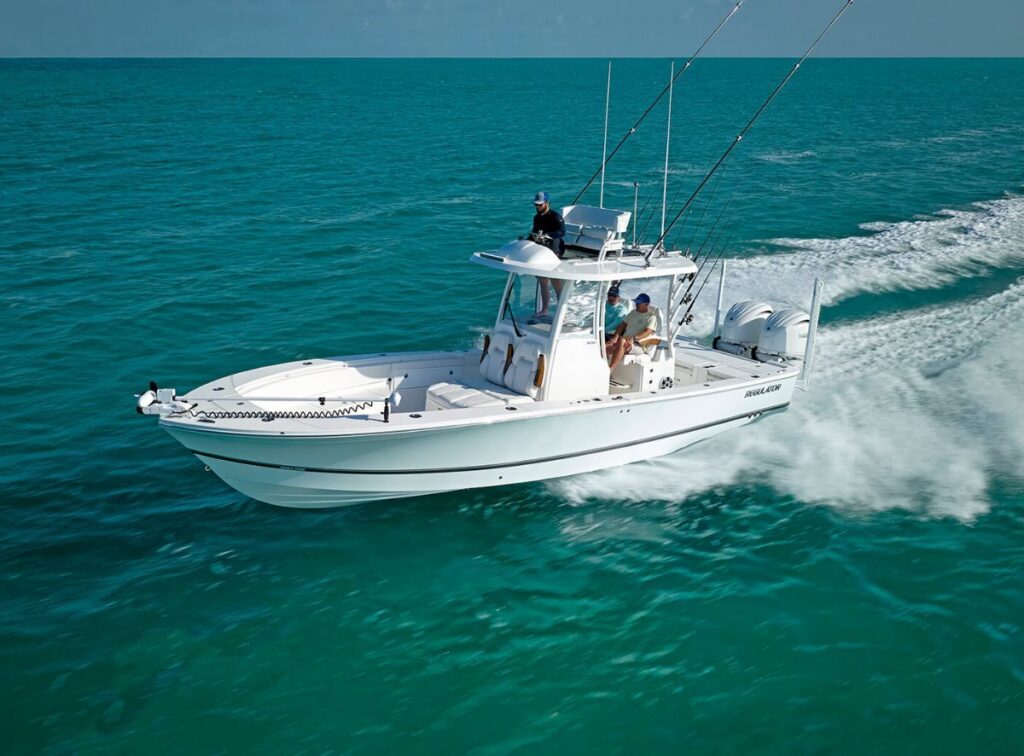
If any brand can stake a claim to the phrase “built for the Gulf Stream,” it may just be Regulator. Thanks to a hand-laid construction, the deep Carolina flare and bluewater pedigree, a Regulator 31, 34 or 41 eats heavy seas for breakfast. The boats were designed and tested off the Carolina coast – where conditions are probably worse than what most days in the Florida Straits have to offer. The Regulator is what you want standing on when a captain has to get back home and the weather had new plans.
The Pre-Crossing Checklist
Every captain should run through a number of categories of preparations before clearing the inlet that turns what could be a more difficult trip into an easier one.
Safety gear is the foundation. That includes USCG and Bahamian compliant life jackets for all persons on board, registered 406MHz EPIRB, an offshore rated liferaft if the boat will be soloing across the Stream, a handheld VHF as backup, in-date flares, a signal mirror, an air horn, ditch bag with passports/cash/satellite communicator like Garmin inReach.
Mechanically, the engines should be serviced and equipped with a complete tool kit along with spare belts and impellers, as well as fuel filters within 50 hours of operation. Backup batteries should be fully charged and bilge pumps tested before the lines come off.
The chartplotter and the chart cards (from Navionics or C-MAP) should be as up to date as possible, a handheld GPS on board and paper charts last line of defence. Any amount of planning (for free!) and a filing with someone on shore is paramount if something goes awry.
Documentation rounds it out. The Click2Clear submission confirmation, passports, boat registration, and insurance documents all need to be aboard, along with cash for the cruising permit and any tips at the marina.
Your First Crossing
Team Up: Any captain who has never made the run should buddy up with a boat making the trip for the first time. When things are right, the crossing is anticlimactic—an 80-minute slide across blue water with flying fish flip-fopping out of the wake and a bottom that pulls away from under your hull. When the white sand of Bimini’s western shore comes into sight, most boaters are asking themselves much later — why did we wait so long?
Ready to find the right boat for the Bahamas program? Stop by any of First Class Watercraft Sales’ three South Florida locations, or get in touch to talk through which Robalo, Grady-White, or Regulator fits the crossing goals. The team has put more boats on the water headed east than just about anyone in the region, and they’ll make sure the right one is sitting under your feet.